


You may also like
-
Rectangular surfaces Poster
Hendrik Nicolaas Werkman · 1930 · Geometric abstract poster of stacked rectangles with bold modernist color contrasts
Poster from €9 · Framed from €16
Regular price From €6,00Regular price -
With the two lost ones Poster
Paul Klee · 1938 · Dreamlike abstract figures art print balancing delicate line and quiet symbolism
Poster from €9 · Framed from €16
Regular price From €6,00Regular price -
Floral still life Poster
Alexej von Jawlensky · 1924 · Vibrant floral art print with bold outlines and modernist blocks of color
Poster from €9 · Framed from €16
Regular price From €6,00Regular price -
Komposition (1939) Poster
Otto Freundlich · 1939 · Geometric abstract poster featuring earthy browns with blue and yellow accents
Poster from €9 · Framed from €16
Regular price From €6,00Regular price


-

"Very nice Posters. The quality is amazing and we received it very quickly !"
-

"A shop to visit absolutely. Huge selection of posters. We spent more than an hour there !"
-

"Perfect to find gift. Price are very good. An they can frame and pack it on site"
About the Artist
Kurt Schwitters (1887–1948) was a German modernist renowned for his pioneering work in collage and his association with the Dada movement. He developed the Merz concept, a radical approach that transformed everyday detritus—tickets, advertisements, scraps—into new forms of artistic expression. Schwitters’ inventive spirit thrived in the dynamic cultural landscape of Weimar Germany, where he reimagined the boundaries of art and design.
Rather than discarding tradition, Schwitters reconstructed it from fragments, elevating the overlooked and ephemeral into significant visual statements. His Merz collages, including this work, reflect a period when artists sought new ways to interpret the rapidly changing world around them.
The Artwork
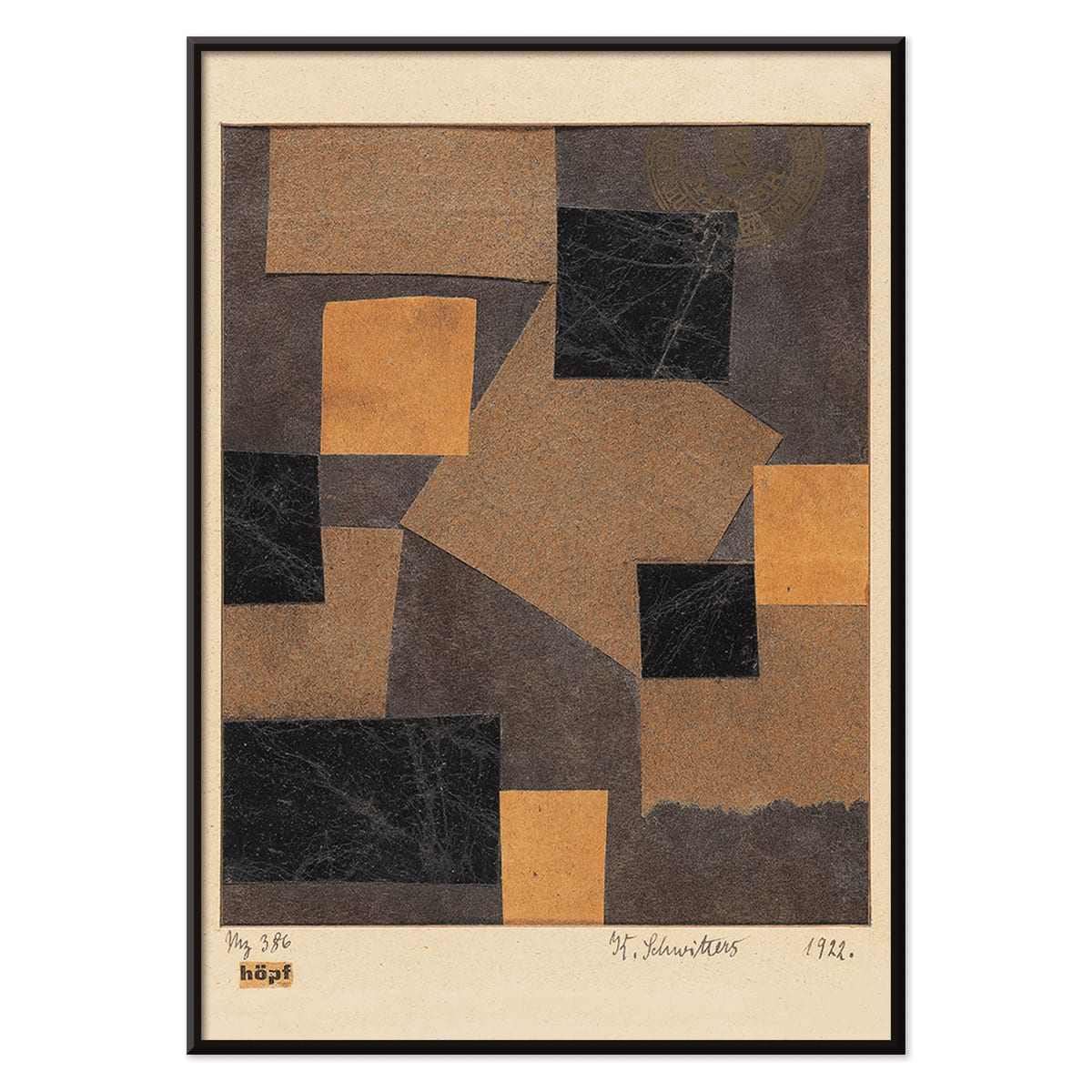
Mz 386 Hopf, created in 1922, is part of Schwitters’ Merzzeichnungen series, which responded to the post-World War I environment by capturing the fragmented energy of modern life. These works do not narrate a single story but instead embody the process of assembling and reassembling meaning from disparate elements. In a time when visual culture was accelerating, Schwitters’ collages offered a new model for understanding the chaos and rhythm of contemporary existence.
This piece stands as an exploration of construction and disruption, inviting viewers to engage with the interplay of order and spontaneity that defined early twentieth-century avant-garde art.
Style & Characteristics
The composition is built from layered paper-like forms and sharp linear accents, with geometric blocks and angled shapes arranged on a warm, beige-toned background. Deep black elements anchor the design, while mid-tone and ochre fragments create contrast and movement across the surface. The overall effect is one of measured dynamism, balancing structure with lively visual tension.
The mood is analytical yet energetic, characteristic of early abstract art. Collectors of abstract wall art and admirers of Bauhaus era design will appreciate the compact, impactful presence of this vintage abstract print in black and beige.
In Interior Design
This art print complements modern living rooms, offices, or entryways where geometric clarity and subtle warmth are desired. Its collage-driven forms harmonize with minimalist interiors, Scandinavian aesthetics, and creative studio environments, especially when paired with clean-lined furnishings and natural textures like wood or linen.
For a cohesive palette, echo the warm beige and ochre tones in surrounding decor, and use black accents in frames or lighting. This minimalist abstract poster also integrates seamlessly into curated beige tone decor, adding a touch of avant-garde sophistication to contemporary spaces.