




-

"Very nice Posters. The quality is amazing and we received it very quickly !"
-

"A shop to visit absolutely. Huge selection of posters. We spent more than an hour there !"
-

"Perfect to find gift. Price are very good. An they can frame and pack it on site"
About the Artist
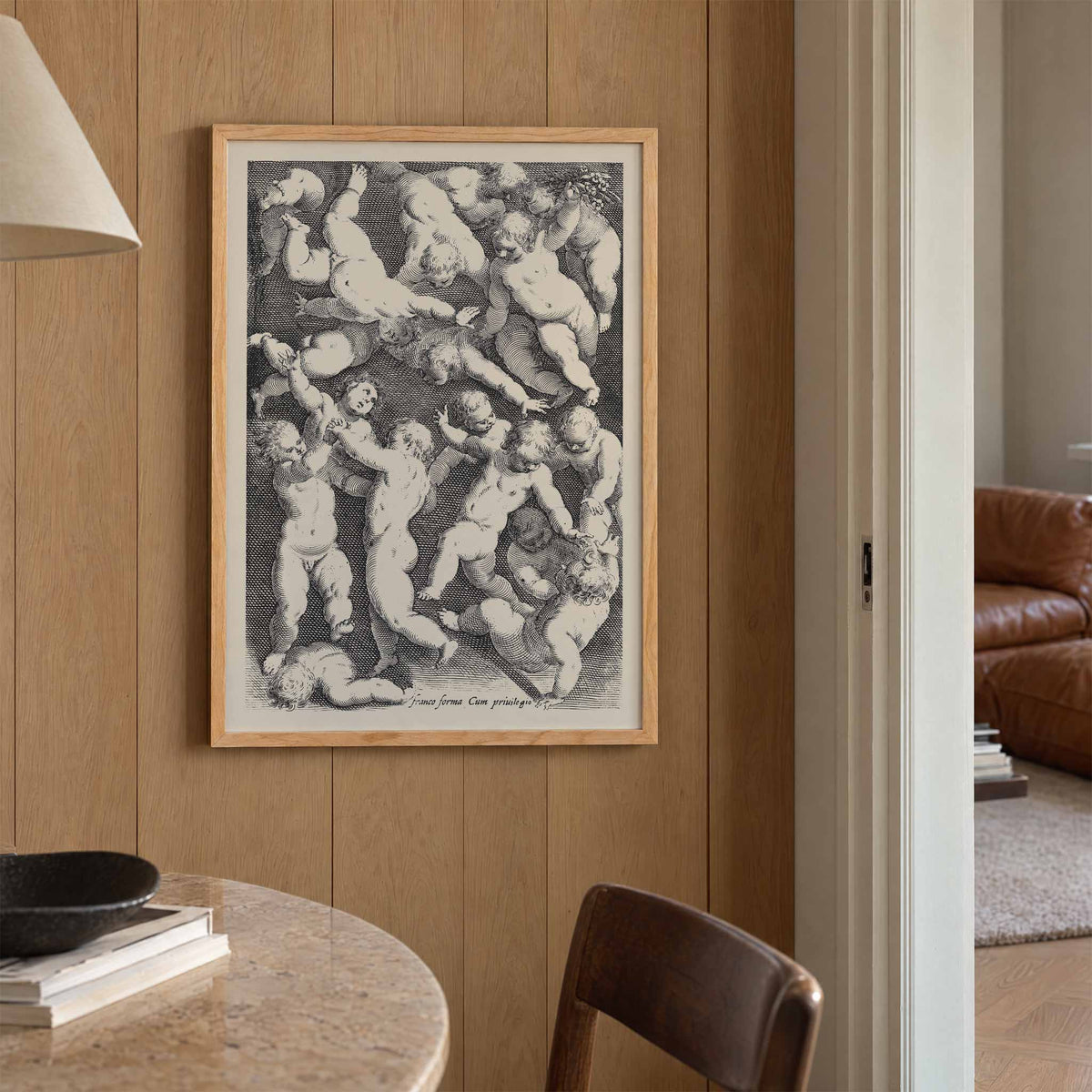
The twisting bodies in this engraving bring the figure studies of Jacopo Palma the Younger into close view. In Venice, Palma painted religious scenes and received commissions for the Ducal Palace, where human gestures carried narratives across much larger surfaces. Drawing the body was fundamental to that work, not simply a preliminary exercise. He died in 1628, making the 1636 publication date of this plate posthumous. This Jacopo Palma the Younger art print offers a smaller scale for exploring his interest in the human figure, away from the monumental settings associated with his Venetian painting.
The Artwork
Learning to invent a convincing figure began with examples such as those gathered in How to draw human bodies. Identified as plate 17 of Rules for learning to draw human bodies, this 1636 engraving served an instructional purpose rather than presenting a standalone narrative. Putti, the child figures familiar from classical and Renaissance art, supplied a subject through which students could study anatomy. As a vintage print from a drawing manual, the sheet preserves an approach to artistic training based on examining established models. Its historical interest lies in that connection between observation and invention.
Style & Characteristics
Pale bodies crowd the sheet, their rounded bellies emerging from densely hatched shadows. At the top, inverted heads and bent legs lead the eye through overlapping figures; farther down, standing children give way to a reclining body along the lower edge. Fine engraved lines follow the curves of limbs, while darker crosshatching separates one figure from another. The cream ground softens the contrast between black ink and unmarked paper. In this classical figure study print, the eye repeatedly shifts between an individual gesture and the tangle of bodies surrounding it, tracing a hand before finding its arm.
In Interior Design
Above a narrow walnut desk in a study, this vertical poster would connect the wall to a sketchbook open beneath it. A slim dark frame would echo the engraved shadows without competing with the figures. Against pale plaster, the fine art print could be examined from the desk chair, where its small gestures remain accessible. Rather than treating home decor as a separate concern, this arrangement makes looking at art part of the working space. The vintage poster brings historical drawing practice into everyday interior decoration, while its role as wall art encourages pauses between pages.