


You may also like
-
Girl and Death Poster
Karl Wiener · 1941 · Surreal memento mori poster featuring a young woman with skeletal silhouette in blue-black tones
Poster from €9 · Framed from €16
Regular price From €6,00Regular price -
Porträt Poster
Karl Wiener · 1923 · Angular modernist portrait art print with bold black linework on beige
Poster from €9 · Framed from €16
Regular price From €6,00Regular price -
Gegenwart Poster
Karl Wiener · 1923 · Modernist abstract poster featuring a black grid against a glowing sunlit field
Poster from €9 · Framed from €16
Regular price From €6,00Regular price -
Farbstudien, 10 Blätter VI Poster
Karl Wiener · 1923 · Vibrant abstract art print balancing orange, blue, and green forms on warm beige
Poster from €9 · Framed from €16
Regular price From €6,00Regular price


-

"Very nice Posters. The quality is amazing and we received it very quickly !"
-

"A shop to visit absolutely. Huge selection of posters. We spent more than an hour there !"
-

"Perfect to find gift. Price are very good. An they can frame and pack it on site"
About the Artist
Karl Wiener was an Austrian modernist whose career spanned the turbulent interwar years. Known for his innovative approach to collage, drawing, and printmaking, Wiener responded to a rapidly changing Europe by exploring the ways visual media could reflect and critique society. His work often intersected with the rise of mass communication, using the language of newspapers and posters to comment on the anxieties and upheavals of his time.
For more works that unite design with cultural commentary, browse our Bauhaus posters and famous artists collections.
The Artwork
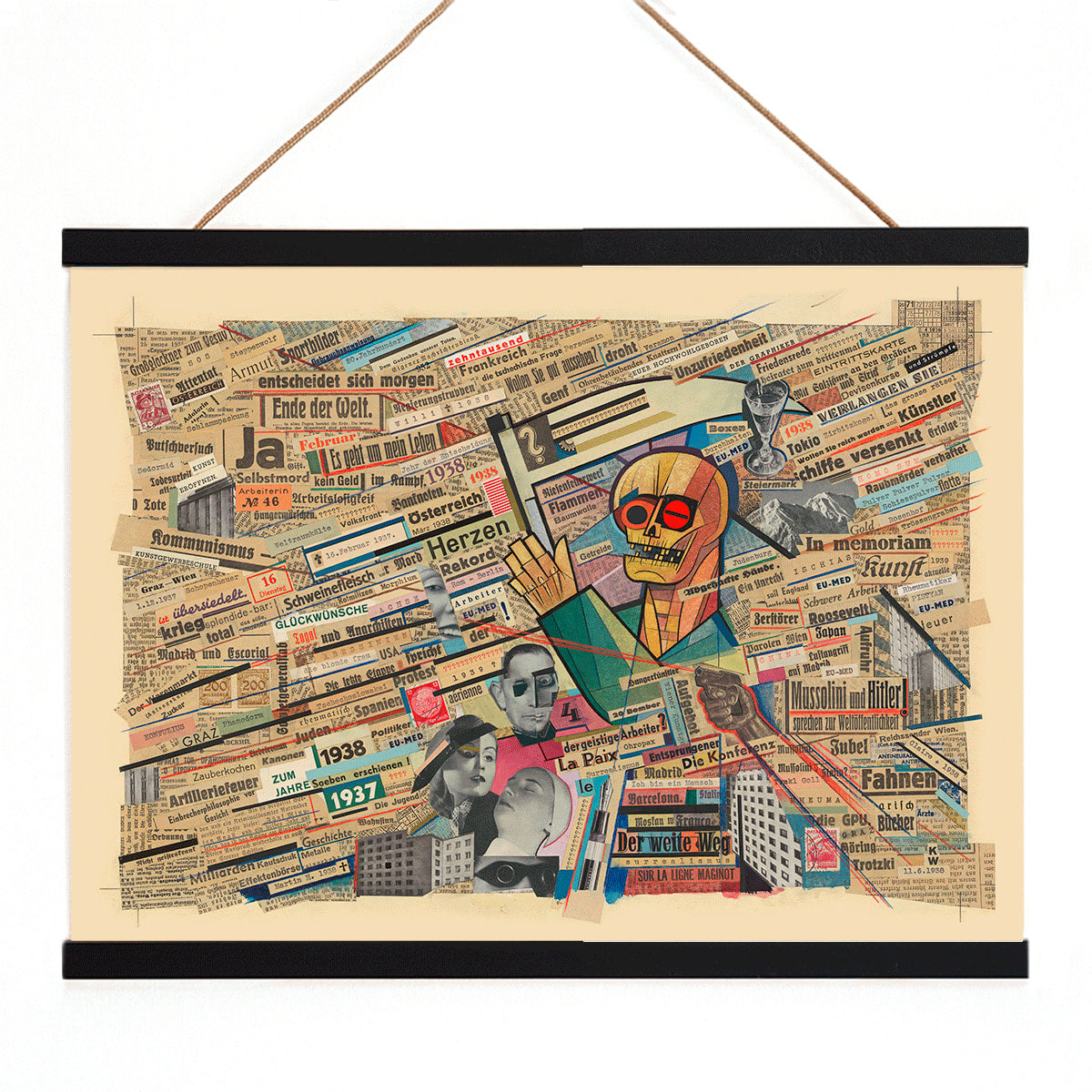
Created in 1938, this collage emerged at a moment when Europe was on the brink of war, and public discourse was dominated by propaganda and uncertainty. Artists like Wiener used collage to process the overwhelming flow of information, cutting and rearranging headlines and images to expose the mechanisms of power and persuasion. This piece stands as a visual document of its era, capturing the tension and fragmentation of a continent in crisis.
Rather than simply reporting events, the artwork transforms the chaos of contemporary news into a critical reflection, encouraging viewers to question how narratives are constructed and consumed.
Style & Characteristics
The composition is built from overlapping newsprint, clipped headlines, and stark graphic symbols, arranged in a dynamic, almost chaotic structure. Dominated by aged beige tones and strong black elements, the collage is punctuated by sharp accents of red, blue, and green, which draw the eye and heighten the sense of urgency. The visual rhythm is restless, with abrupt juxtapositions and fragmented imagery that evoke the sensation of scanning a newspaper in a time of crisis.
This expressive yet archival quality gives the art print a tactile presence, blending documentary realism with avant-garde experimentation. For similar works, explore our abstract wall art and black and white prints.
In Interior Design
This art print is well suited to interiors that favor conversation and intellectual engagement, such as living rooms, studies, or creative workspaces. Its graphic intensity complements minimalist, mid-century, or industrial decor, where its layered textures and historical resonance can stand out. Pair with neutral furnishings and echo the print’s color accents in accessories or textiles for a cohesive look.